Boeng Tuk Commune | Kampot Province
Office
Police
096 773 9343 088 870 2565 088 786 0884
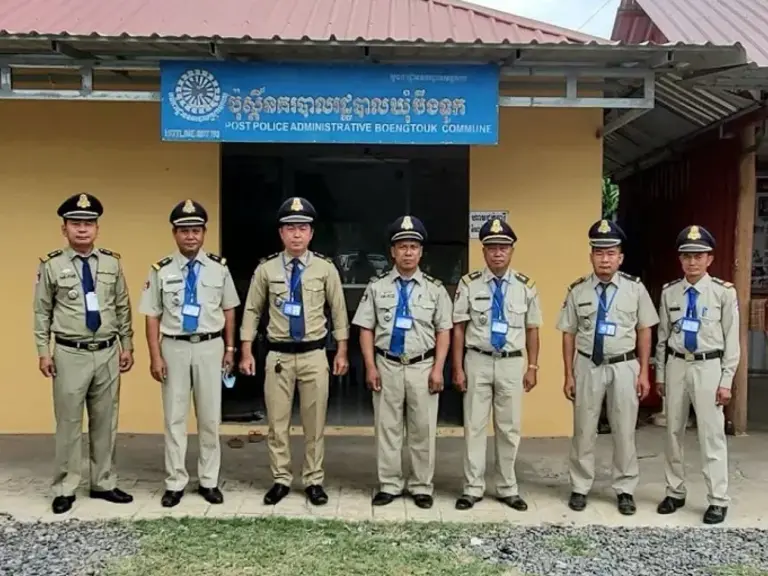
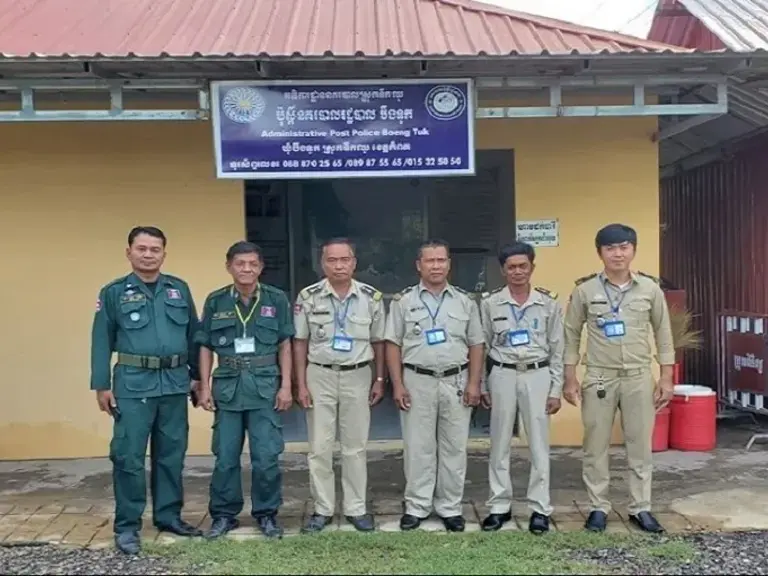
Geographic location and administrative context:
Its boundary runs along the eastern bank of the Prek Kdam River, which separates it from the commune of Sampeang. Official provincial maps place Boeng Tuk in a low‑lying alluvial plain that opens toward the Gulf of Thailand’s watershed zone to the south‑west.
Land area:
According to the Ministry of Planning’s 2019 Gazetteer of Communes, Boeng Tuk covers 48.6 km² (≈ 19,050 acres). The commune is divided into a central cultivable zone of rice paddies and an outlying mangrove strip that forms part of the larger Kampong Bay Mangrove Conservation Area designated under Sub‑Decree No. 1234‑RGD/2018.
Population:
The 2019 Cambodia Commune Census, administered by the National Institute of Statistics, recorded a total population of 7,896 residents in Boeng Tuk. Of these, 3,958 were male and 3,938 female, yielding an almost balanced sex ratio (̂= 1.004). Age structure shows that 61 % of the population is under 30 years; median age is 23 years.
Administrative subdivision:
Boeng Tuk is organized into four villages (phum): Boeng Tuk, Kampong Saong, Prey Chak, and Svay Ror. Each village contains several hamlets (12 in total). Village heads report to the Commune Development Committee (CDC), which meets monthly with District officials to coordinate service delivery.
Economic basis:
- Cultivated land: Boeng Tuk has 10.4 km² of cultivated parcels (≈ 21 % of total area). According to the Provincial Department of Agriculture’s 2021 field survey, paddy rice occupies approximately 6.5 km², yielding an average production of 4.7 t/ha. Secondary crops include cassava (≈ 3.1 km²) and corn (≈ 1.2 km²).
- Aquaculture: The brackish creeks that feed into the Prek Kdam River support fish‑pond systems covering around 4.8 ha. Provincial fisheries statistics for 2022 report an output of 13 t of pangasius catfish, 7 t of tiger shrimp (Penaeus monodon), and 11 t of tilapia from these ponds.
- Livestock: Households keep on average 52 chickens per family unit; water buffaloes are present on 34 % of households with a mean herd size of nine animals, as documented in the Ministry of Agriculture’s 2020 livestock census.
- Non‑agricultural activities: Small‑scale trade, construction timber harvesting from the peripheral mangroves (licensed under Commune Forest Management Plan No. 7‑2019), and seasonal tourism related to nearby archaeological sites generate supplementary income for a portion of households.
Infrastructure details:
- Road network: The primary access route is an earthen road classified as Class III that links Boeng Tuk directly to National Road 3, providing connectivity to Kampot City and the provincial capital Phnom Penh (≈ 120 km north). Internal tracks are lateritic; they become intermittently impassable during intense rain periods (peak monsoon: September–October), prompting occasional use of tracked vehicles by emergency services.
- Electrification: The Rural Electrification Agency extended the national grid to 68 % of households in 2019. Remaining residences rely on diesel generators or solar home systems installed under the World Bank Energy for All – Phase I program (pilot sites: Kampong Saong and Prey Chak).
- Water supply: Piped potable water reaches 38 % of households; the remainder collect rainwater harvested from rooftops and store it in concrete tanks with basic sand filtration systems approved by the Commune Health Office. Groundwater extraction for irrigation is regulated under Sub‑Decree No. 567/2015 on Well Construction.
- Education: Boeng Tuk Primary School enrolls 932 pupils (grades 1–6); a secondary school (Kampong Saong Secondary) registers 358 students in grades 7–9. The institutions receive an annual operating subsidy of roughly 0.72 million Riel each, as granted by the Provincial Department of Education for fiscal year 2022‑23.
- Health services: The Commune Health Centre employs one midwife and two medical assistants; it provides basic curative care, antenatal visits, childhood immunisation, and disease surveillance. A Village Volunteer Clinic operates in Prey Chak under a contract with the Ministry of Health, supplying monthly medication kits for malaria treatment.
Environmental characteristics:
The southern fringe of Boeng Tuk contains approximately 360 ha of mangrove forest that was officially incorporated into the Kampong Bay Mangrove Conservation Area in 2018 (Management Plan No. 9‑RGD/2018). This area supports a documented assemblage of organisms, including Scylla serrata and seasonal sightings of estuarine dolphins (Tursiops truncatus), as confirmed by the Cambodia Biodiversity Research Unit’s 2021 annual report. Sustainable fuel‑wood collection under prescribed cut‑harvest cycles is permitted for village households in accordance with Commune Forest Committee regulations.
Climatic conditions:
Boeng Tuk experiences a tropical monsoon climate characterised by an average annual rainfall of 2,371 mm, concentrated between May and October (accounting for roughly 80 % of total precipitation). Mean daily temperature ranges from 26 °C in the cooler months to 31 °C during the hot season; relative humidity fluctuates between 70 percent and 85 percent annually.
Recent development initiatives:
In August 2023, the Kampot Provincial Office of Rural Development partnered with the Asian Development Bank (ADB) on a Integrated Rice‑Fish Production System pilot covering 41 ha of flood‑plain paddies in Prey Chak. Preliminary monitoring data released by ADB’s Phnom Penh office indicate an average rice yield increase of 9 percent, fish production of 2.3 t/ha, and a rise in soil organic carbon from 0.78 % to 1.04 % within the project area (ADB Project Report, October 2023). The program is slated for expansion across all villages of Boeng Tuk by fiscal year 2025 under the province’s Sustainable Livelihood Enhancement Plan.
Bokor City Getting to Bokor Mountain Camping Hydroponic Farm Lake Bokor Municipality National Park Old Catholic Church Old Royal Residence Hill Station Bokor Police Popokvil Waterfall Preah Puth Padima Statue Sokha Real Estate Sampov Pram Pagoda Sokimex Gas Station Strawberry Farm Thansur Sokha Yeay Mao Monument